NFPA 72 Fire Alarm Schematic Diagrams: Reading Riser Drawings Like a Pro
Why the Schematic Diagram Matters
A fire alarm schematic, often drawn as a riser diagram, is the single document that ties every component of the system together. It is the blueprint used for installation, commissioning, maintenance, and troubleshooting. Before any field work happens, someone is reading this drawing to figure out where the control panel sits, how the loops snake through the building, and where the notification appliances terminate.
Imagine a scenario where you are inside a particular building and suddenly there is a fire — how do you know that there is a danger? That is where the fire alarm system comes into picture.
The fire alarm system constantly monitors for smoke and heat. When a detector trips, the control panel actuates the horns and strobes so occupants can evacuate. The schematic is how we verify, on paper, that every one of those signal paths is wired correctly and in compliance with NFPA 72.
The Core Components on Every Riser
Almost every NFPA 72 schematic shows the same skeleton:
- Fire Alarm Control Panel (FACP) — the brain of the system
- Initiating devices — smoke detectors, heat detectors, manual pull stations
- Notification appliances — horns, strobes, horn/strobes, speakers
- Primary power supply — typically 120/220 VAC from the building service
- Secondary power supply — sealed lead-acid batteries sized per NFPA 72 Chapter 10
NFPA 72 Chapter 10 requires both a primary and secondary power supply so the system remains functional during a utility outage. Battery sizing is its own exercise — you calculate standby current for the required period (typically 24 hours) plus alarm current (typically 5 or 15 minutes depending on occupancy), then apply a derating factor.
Loop Wiring vs. NAC Circuits
Two terms that show up on every schematic trip up a lot of newcomers:
- SLC / Loop wiring — the Signaling Line Circuit that connects initiating devices back to the panel. On an addressable panel, one loop can typically carry 200–250 devices depending on the manufacturer.
- NAC wiring — Notification Appliance Circuits that carry the 24 VDC signal out to horns, strobes, and speakers.
A typical single-loop addressable panel has one SLC terminal pair and four built-in NAC circuits. From the schematic, you should be able to count every device on the SLC and every appliance on each NAC and match it against the panel’s published capacity.
Class A vs. Class B Wiring
This is the concept that separates people who can read a riser from those who are still guessing. NFPA 72 Chapter 12 defines circuit performance classes, and Class A and Class B are the two you will see most often on commercial drawings.
Class A wiring:
- Uses four wires
- Routes from the panel, through every device, and returns to the panel
- Power is fed from both directions
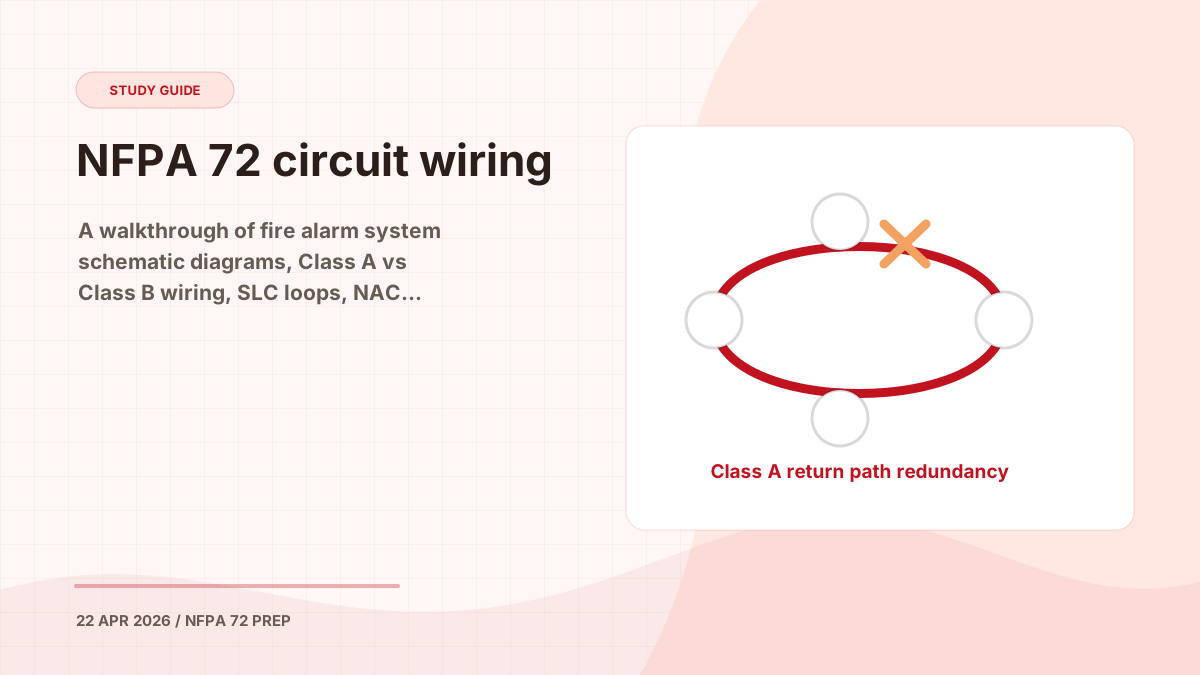
- A single open (one cut wire) does not disable downstream devices
- Required survivability makes it the typical choice for SLC and IDC runs
Class B wiring:
- Uses two wires
- Routes from the panel through every device and terminates at an end-of-line resistor (EOLR)
- Power is fed in one direction only
- A single open disables every device past the break
- Commonly used for NAC circuits feeding horns and strobes
In Class A the wiring will be returned to the panel after connecting to the devices. In Class B the wiring will not return to the panel, and we will close this wiring by using an end-of-line resistor.
On the schematic, Class A shows up as a loop that leaves the panel and comes back in on a separate pair of terminals. Class B shows up as a dead-end run terminated with that characteristic EOLR symbol.
Addressable vs. Conventional Panels
The schematic tells you immediately which panel type you are dealing with. An addressable panel uses an SLC where every device carries a unique address — programmed in the panel and referenced on the drawing as something like L1-SD-01 (Loop 1, Smoke Detector 01). A conventional panel has no addresses; it groups devices into zones, and all you see on the schematic are Zone 1, Zone 2, Circuit 1, Circuit 2, etc.
The difference matters when a fire occurs:
- Conventional panel: you know the fire is somewhere in Zone 2. You still have to walk the zone to find the device.
- Addressable panel: the panel display reads “L1-SD-14, Corridor, 3rd Floor.” Responders go straight to the point of origin.
The main advantage of the addressable fire alarm panel is that if the fire occurs in a particular area, the device number shows on the panel so we can easily identify exactly which device has detected the fire.
From an exam standpoint, NFPA 72 Chapter 23 covers protected premises fire alarm systems, and the distinction between addressable and conventional shows up repeatedly when questions ask about identification granularity, device limits, and circuit survivability.
Wire Sizing on the Schematic
A well-drawn riser calls out conductor sizes next to each run. Typical values you will see on NFPA 72 drawings:
- SLC / Initiating circuits: 16 AWG (approximately 1.5 mm²)
- NAC circuits: 14 AWG (approximately 2.5 mm²) for horns and strobes
These are starting points. The actual size depends on the run length, the number of appliances, and the voltage drop calculation. NFPA 72 and the appliance listing require that the voltage at the last strobe on the circuit stays above the minimum operating voltage — often 16 VDC on a nominally 24 VDC system. If the drop is too high, you either upsize the conductor, split the circuit, or add a NAC booster.
What a Complete Riser Should Show
When you submit a fire alarm shop drawing package, the riser diagram should include:
- The FACP with loop and NAC terminals labeled
- Every initiating device with its address or zone assignment
- Every notification appliance with its circuit assignment
- Wiring class (Class A or Class B) called out in the notes
- Conductor size and type for each circuit
- End-of-line resistor locations for Class B circuits
- Primary and secondary power details
- A device legend keyed to symbols on the drawing
Reviewers use this to verify you haven’t exceeded panel capacity, blown the voltage drop budget, or mixed up survivability classes. The drawing is also what a service tech pulls out in year seven when a strobe drops off the circuit and nobody remembers where the EOLR actually is.
How Fire Code Mastery Fits Into This
Schematic reading is one of the most heavily tested topics on the NFPA Certified Fire Alarm Designer and CFPS exams — and it connects directly to wire sizing, voltage drop, battery calculations, and circuit class selection. The Fire Code Mastery app is built to drill exactly these topics:
- 3,450+ exam questions covering Chapters 10, 12, 17, 18, 23, and 24 — including SLC, NAC, Class A/B, and riser interpretation items
- 10+ built-in calculators for battery sizing, voltage drop on NAC circuits, and conductor ampacity, so you can verify schematic values instead of guessing
- Flash cards for memorizing device symbols, circuit classes, and survivability categories
- Case studies that walk you through real riser diagrams and ask you to identify errors
- Mock tests timed and scored to match the real exam conditions
If you can read a riser cold — naming the class, counting the devices, and catching a missing EOLR — you are well on your way to passing the exam and designing systems that actually get approved on the first submittal.
Prepare for your exam with our mobile app
3,450+ practice questions with detailed explanations