NFPA 72 Class A Fire Alarm Wiring Explained
What NFPA 72 Actually Says About Class A Wiring
Class A wiring is one of those topics that shows up on the NFPA 72 exam in several different forms — circuit class, pathway survivability, and installation requirements. The foundation is in Chapter 12 — Circuits and Pathways, and specifically in the Class A definition under Section 12.6.2. The rule is short, but the consequences for design are substantial:
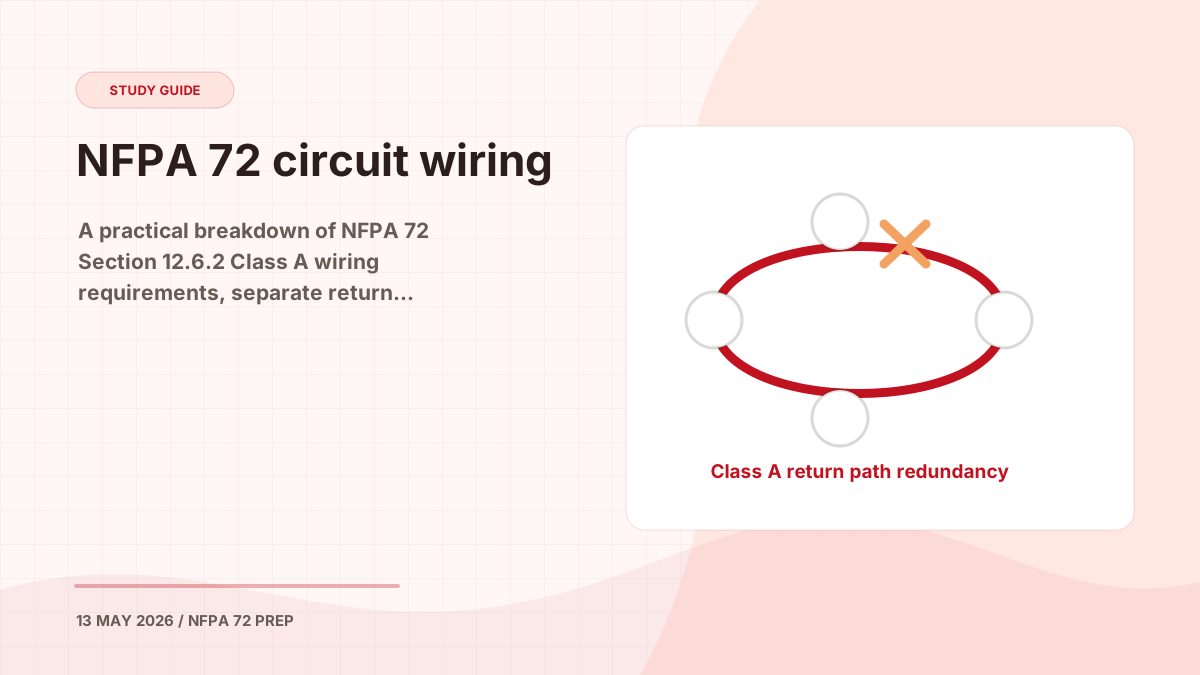
Where Class A wiring methods are employed, the conductors must return to the control panel via a path that is distinct and separate from the outgoing conductors.
In other words, a Class A circuit is a loop. Signals leave the fire alarm control unit (FACU), pass through every initiating device or notification appliance on the circuit, and come back to the panel on a second set of conductors. That return leg is what makes Class A Class A — and the code is very particular about how it has to be installed.
Why the Return Path Has to Be Separate
The whole reason Class A exists is fault tolerance. A Class B circuit, by contrast, is a stub: if a wire breaks halfway down the run, every device past the break is invisible to the panel. Class A is engineered so that a single open or short doesn’t take the circuit out of service.
That promise only holds if the outgoing and return conductors don’t share a fate. If both pass through the same conduit, the same plenum penetration, or the same junction box, then one accident — a falling beam, a careless drill bit, an unexpected fire event — can sever both legs at once. The redundancy collapses.
So NFPA 72 doesn’t just require a return path; it requires that the return path be protected against physical damage and routed so it isn’t subject to the same hazards as the outgoing conductors.
Typical protection methods include:
- Metallic conduit or EMT for the return leg
- Cable trays separated from the outgoing run
- Fire-rated cable assemblies (CI cable) where pathway survivability is required
- Routing the two paths through different parts of the building — opposite walls, different floors, or different risers
Supervision and Fault Tolerance — The Mechanism Behind the Rule
Class A only works because the FACU is constantly supervising the circuit. Every fire alarm circuit installed under NFPA 72 is supervised — the panel sends a small monitoring current down the conductors and watches for opens and shorts. Any change in circuit integrity is annunciated as a trouble condition at the panel.
In a Class A configuration, that supervision does double duty:
- It tells you when something has gone wrong (the trouble signal).
- It allows the panel to electronically isolate the fault and continue communicating with every device through the surviving path.
So a single open on the outgoing leg of a Class A loop produces a trouble at the panel, but every smoke detector, pull station, and notification appliance on that circuit continues to function — alarms still come in, horns and strobes still operate. That’s the survivability story Chapter 12 is trying to tell.
Class A vs. Class B — When the Code Forces Your Hand
NFPA 72 itself doesn’t usually mandate Class A. It defines the classes; the applicable building code, fire code, or the Authority Having Jurisdiction (AHJ) decides which one you have to use. In practice, Class A shows up where the consequences of a partial system failure are unacceptable:
- Hospitals and other healthcare occupancies where evacuation isn’t a realistic option
- High-rise buildings with long, complex egress paths
- Detention and correctional facilities
- Critical infrastructure and certain industrial occupancies
Class B is the default for most ordinary occupancies because it’s cheaper and simpler — fewer conductors, no return run, less conduit, less labor. But Class B carries the single-point-of-failure risk, and that’s not a trade you want to make in a 30-story tower.
Installation Considerations the Exam Loves to Test
When designing a Class A circuit, a few practical decisions show up over and over in NFPA 72 study material:
- Physical separation of the two legs. Running the outgoing along one corridor and the return along another isn’t a suggestion — it’s the entire point of Class A. Two conductors in the same jacket aren’t a Class A circuit.
- Pathway Survivability Levels (Chapter 12, Section 12.4). Class A handles single faults; pathway survivability Levels 0–3 address how long the circuit must survive fire exposure. The two requirements stack.
- Fire-rated cable and conduit. Where survivability is required by the building code, the return path may need to be in 2-hour rated construction or installed using a listed CI (circuit integrity) cable system.
- Mechanical support. Cables must be securely fastened and protected against pulling, sagging, or abrasion. NEC Article 760 applies to the wiring itself.
- Junction box discipline. Common failure point: outgoing and return conductors landing in the same JB. If the box is damaged, both legs go down — defeating the redundancy.
Inspection, Testing, and Maintenance
Class A reliability lives or dies in Chapter 14 — Inspection, Testing, and Maintenance. The test that proves a Class A circuit is doing its job is straightforward:
- Introduce a single open fault somewhere on the circuit.
- Verify the panel annunciates a trouble.
- Activate an initiating device past the fault.
- Confirm the panel receives the alarm via the return path.
If alarms still come in with the outgoing leg open, the redundant path is working. If they don’t, you’ve got either a wiring error, a shared pathway, or a panel configuration problem. Annual testing per Table 14.4.5 (and more frequent visual inspections) is the minimum for most systems.
Where Class A Fits in a Complete Fire Protection Strategy
Class A wiring is a single tool in a much bigger toolbox. A real fire protection design layers detection (smoke and heat detectors per Chapter 17), notification (Chapter 18), suppression (sprinkler systems under NFPA 13), and emergency communications. Class A makes the signaling portion of that system tolerant of a single fault — but it doesn’t replace any of the other layers. The exam tests this integration constantly.
How Fire Code Mastery Fits Into This
Class A wiring is one of the highest-yield topics on the NFPA 72 certification exam — it shows up in pathway classification questions, survivability questions, installation questions, and ITM (inspection, testing, maintenance) questions. The Fire Code Mastery app is built to make all of that drillable:
- 3,450+ exam questions covering Chapter 12 circuit classes, pathway survivability levels, and Class A/B/X/N differences
- 10+ calculators for voltage drop, battery sizing, candela spacing, and other design math that pairs naturally with circuit-class decisions
- Flash cards for the definitions in Chapter 3 — including Class A, Class B, Pathway Survivability, and Supervision
- Case studies that walk through realistic Class A installations in high-rises, hospitals, and mixed-use occupancies
- Mock tests modeled on the actual NICET and AHJ-style exams, with Chapter 12 weighted the way the real exams weight it
If Class A wiring still feels abstract, the fastest way to lock it in is to see the same concept tested ten different ways. That’s exactly what the app is designed to do.
Prepare for your exam with our mobile app
3,450+ practice questions with detailed explanations