NFPA 72 and NEC Requirements for Fire Alarm Systems Explained
Two Codes, One Life Safety System
Anyone designing, installing, or maintaining a fire alarm system is working from two rule books at once: NFPA 72, the National Fire Alarm and Signaling Code, and the National Electrical Code (NEC / NFPA 70). They do different jobs but they cannot be applied in isolation.
NFPA 72 provides the requirements for the design, installation and maintenance of fire alarm systems while the NEC provides the requirements for the electrical wiring and equipment used in these systems.
Said another way — NFPA 72 tells you what the system must do. The NEC tells you how the conductors, raceways, overcurrent protection, and grounding must be installed so the system can actually do it.
The NFPA 72 Chapters That Matter Most
Six chapters of NFPA 72 carry most of the weight for everyday fire alarm work:
- Chapter 2 — Definitions. Terminology drives interpretation. If you don’t know what NFPA 72 means by initiating device, survivability, or pathway, you cannot apply the rest of the code correctly.
- Chapter 5 — General Requirements. Sets the baseline expectations for design, installation, and maintenance — the framework that the more specific chapters build on.
- Chapter 6 — Protected Premises Fire Alarm and Signaling Systems. Covers fire alarm control units (FACUs), initiating devices like detectors and pull stations, and notification appliances. This chapter governs how individual components are integrated and how the system performs as a whole.
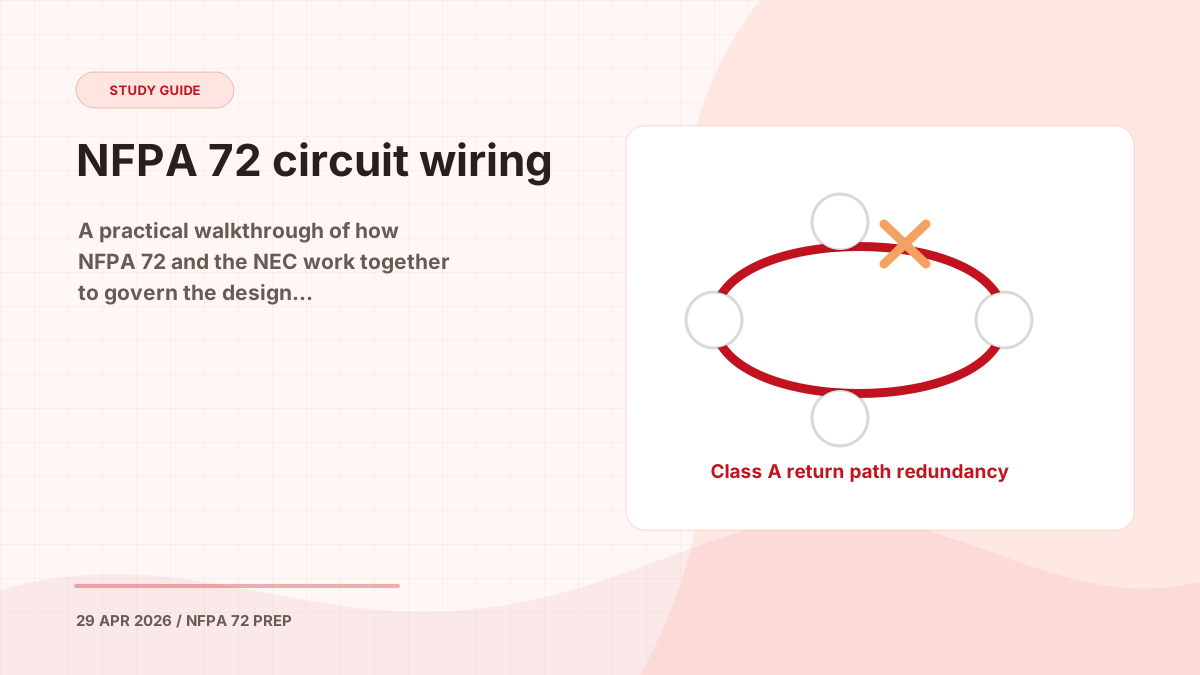
- Chapter 7 — Pathway Survivability and Wiring. Addresses circuit classes, pathway designations, wiring methods, conductor types, and signal integrity — the bridge between NFPA 72 and the NEC.
- Chapter 10 — Inspection, Testing, and Maintenance. The chapter that keeps systems alive in the field. ITM frequency, qualifications, and documentation all live here.
- Chapter 19 (formerly Chapter 24) — Emergency Communications Systems (ECS). Covers in-building voice evac, mass notification, two-way emergency communications, and area-of-refuge phones.
The role of emergency communication systems as covered in NFPA 72 is to provide clear and understandable information to building occupants during an emergency.
Where the NEC Picks Up
Once you cross from “what the system does” to “how the copper is run,” the NEC takes over. The articles you’ll reach for most often:
- Article 760 — Fire Alarm Systems. The core NEC article for fire alarm circuits. It distinguishes between power-limited (PLFA) and non-power-limited (NPLFA) circuits, sets overcurrent protection requirements, defines cable types (FPL, FPLR, FPLP), and dictates separation from other circuits.
- Article 800 — Communications Circuits. Applies where communications wiring is used as part of the fire alarm or signaling pathway.
- Article 840 — Premises-Powered Broadband Communications Systems / Emergency Power Considerations. Comes into play for the backup power infrastructure that keeps a fire alarm system alive when utility power is lost.
The NEC also covers the separation of fire alarm circuits from other electrical circuits, minimizing the risk of interference or faults affecting the fire alarm system.
Power-Limited vs. Non-Power-Limited Circuits
Article 760 splits fire alarm circuits into two camps because the safety strategies differ:
- Power-limited fire alarm (PLFA) circuits — energy is restricted at the source (typically inside the FACU’s listed power-limited output). This permits smaller cable types and reduced separation requirements.
- Non-power-limited fire alarm (NPLFA) circuits — no source-side energy limit, so the wiring methods, overcurrent protection, and separation from light and power circuits look much more like Chapter 3 wiring.
Picking the wrong category — or mixing PLFA and NPLFA conductors in the same enclosure without the required separation — is one of the most common Article 760 violations on inspection.
Wiring, Grounding, and Separation
The reliability of a fire alarm system rises and falls with its wiring. NFPA 72 Chapter 7 and NEC Article 760 work in tandem on:
- Conductor sizing and type appropriate for the load, environment, and required pathway survivability level.
- Support and protection of cables — proper bushings, sleeves, and physical protection where cables transition between areas.
- Grounding of equipment and shields, sized and bonded per the NEC, to control fault currents and reduce shock hazard.
- Separation between fire alarm circuits and Class 1, light, and power circuits to prevent induced faults from disabling the system.
Inspection, Testing, and Maintenance
NFPA 72 Chapter 10 is where many systems quietly fail compliance — not because they were installed wrong, but because they weren’t kept right. The chapter requires:
- Initial acceptance testing of every device and pathway
- Periodic inspection (visual) and testing (functional) at intervals based on device type and occupancy
- Maintenance by qualified personnel
- Written records of every inspection, test, and impairment
NFPA 72 also requires that all fire alarm systems be maintained in good working order. This includes repairing or replacing any defective components and ensuring that the system is properly programmed.
A common audit finding: smoke detector sensitivity testing skipped, batteries not load-tested, or NAC circuits never re-verified after a programming change.
Detectors, Notification, and Control Units
Chapter 6 of NFPA 72 governs the building blocks of every system:
- Detection — smoke, heat, and flame detectors, each suited to a specific fire signature and environment. Spacing and location rules in Chapter 17 (referenced from Chapter 6) drive detector layout.
- Notification appliances — horns, speakers, and strobes selected for the required sound pressure level (audibility) and candela rating (visibility) per occupancy.
- Fire alarm control units — receive signals from initiating devices and command notification, ancillary functions, and off-premises signaling. Programming must reflect the approved sequence of operation.
Emergency Power: Keeping the System Alive
A fire alarm system is only useful if it works when the lights go out. NFPA 72 requires a secondary (standby) power source — typically batteries sized for 24 hours of standby plus a defined alarm period, or a generator backed by 4 hours of battery. The NEC governs the installation of that standby source, the disconnects, the transfer equipment, and the conductors feeding the FACU.
The Bottom Line
Compliance with both codes is critical for protecting life and property from fire.
NFPA 72 and the NEC are complementary, not redundant. Plan, design, install, test, and document with both in hand — and stay current with the latest editions, because both codes update on a three-year cycle.
How Fire Code Mastery Fits Into This
If you’re preparing for a NICET, state, or AHJ-administered fire alarm exam, you cannot just memorize Article 760 or Chapter 10 in isolation — you have to be fluent in how the two codes interact. The Fire Code Mastery app is built around that exact need:
- 3,450+ exam questions drawn from every chapter referenced above — Chapters 2, 5, 6, 7, 10, 19, plus Article 760, 800, and 840 questions
- 10+ built-in calculators for battery sizing, voltage drop, NAC loading, candela coverage, and other day-job math you’ll see on the exam
- Flash cards for definitions from Chapter 2 and quick-recall items from Article 760
- Case studies that walk through real installation, ITM, and ECS scenarios — the kind of integrated problems exams love
- Mock tests timed and weighted to mirror the actual exam blueprint, so you walk in knowing the pacing
Whether you’re sitting for NICET Level I-IV, prepping for a state license, or just sharpening your code knowledge for the field, working through the app alongside the NFPA 72 and NEC handbooks is the fastest way to make these chapters and articles second nature. We keep a short list of the editions and study guides we actually use on our recommended books and tools page.
Prepare for your exam with our mobile app
3,450+ practice questions with detailed explanations